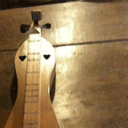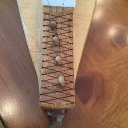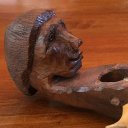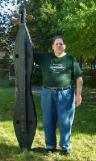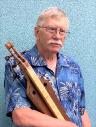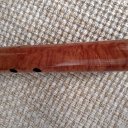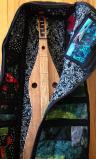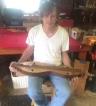
Leonard Glenn Dulcimer, 1972
General mountain dulcimer or music discussions
Go for it!
Ken
"The dulcimer sings a sweet song."
Go for it!
Ken
"The dulcimer sings a sweet song."
Sounds like a good starting point for dickering on the price.
Congratulations on finding a Fred Martin. My first was a Fred that I bought from him in 1987 or 88. Yes, they were all 4 equidistant strings. The bridge and nut are plastic. I broke the nut on mine and Keith Young made a new one for it. I agree with Ken's choices for strings, although I think I do have 09s on mine. Fred, however, used very heavy strings and tuned them D A d d. I used to cringe every time I changed the tuning and needed to go back up to d on the melody strings. I also agree with Ken on Murphy's Oil Soap. Then either a light coating of Martin Guitar Polish or Dr. Duck's Axe Wax. I just starting using Dr Duck's and am impressed with it. I wouldn't sand and refinish it. Scratches give an instrument some character! As for the pegs you can either spit on them or use some chalk ( i prefer billiard chalk.) Fred was pretty good at fitting pegs so you shouldn't have much problem. Oh, Fred didn't use a noter so get to working out those fingers. LOL
You can use this website to calculate the string size: http://www.strothers.com/string_choice.html . It tends to be a little on the light side. When I did the calculations, I came up with D = 0.018, A = 0.012, and d = 0.0090. I would suggest trying 0.020, 0.014, and 0.010. When you take the strings off, you can use a small block of wood and hammer to knock the pegs out if they do not come out on their own. You can clean them off with a mild soap. Murphy's Oil Soap works well. A small amount of peg dope available from a violin or music shop can help lubricate the pegs for easy turning and grip. I also use the Murphy's for cleaning the entire instrument. Where the scratches are, you might need to sand them out and refinish the area. It depends upon how much you want go get rid of them. Best wishes on your project and the new (to you) dulcimer.
Ken
"The dulcimer sings a sweet song."
Greetings!
I found a beautiful, but filthy, Fred Martin dulcimer at Goodwill and need help in learning how to clean it, how to string it (what gauges would be correct for this dulcimer, wound bass or not?), and how best to get the most out of the tuning pegs.
The dulcimer has 29" scale.
Per label it is made of native black walnut back, sides and headstock (how about that eqyptian??? What a beauty!), maple soundboard and tuning pegs, oak fretboard.
The string pins are dowels angled into the tail.
the nut and bridge feel like bone, not a highly polished or glassy dense bone, but something more akin to the way cuttle bone feels. Anyone know what he and or edsel used for their nuts and bridges and whether they did set up four equidistant or not? The bridge is REALLY high (suspension bridge high, and no way to play above seventh fret without bodybuilding first)
I had originally hoped to find both an edsel and a fred martin more for the woodworking, americana aspects than for playing, especially since i cannot play a long scale in my preferred style.
BUT, i have tuned the greasy gunky awful old strings to CGC and given it a quick run at rosin the beau and am pleasantly surprised. The pegs are holding the tuning pretty well, and intonation is far better than i expected. So it looks like I will be learning noter drone.
So, oldtimers and seasoned pros..
how do I clean the wood (prior owner braided a hunk of baling wire to make a very primitive strap, some of the broken wires scratched the back of dulcimer and i would like to clean that up if possible)
How do i get the pegs turning and tuning properly...very afraid i am going to break one as i tighten strings. What gauge strings should i be using? How do i properly lower the bridge so that strings are in same zipcode as frets?
is there anything else i need to know?
thanks a million for your help in preserving, and playing this nice bit of history.
George, put on your swim trunks, pinch your nose and jump in! Fortune has smiled upon you, my son...
Sounds good to me! Jump! Jump!
I have some one wanting to sell me a Leonard Glenn, 1972, 3 string, looks to be in perfect condition, has label inside, they are asking $300.00, should I jump on this or is that a silly question?
Don't know what they are worth as that changes by each buyer, but that sounds like a good price.
Thanks for posting this. I've been listening to a lot of podcasts (and audiobooks) of late. I've just listened to three episodes and found them to be well done.
I'm still relatively new to the dulcimer (and the piano is my primary instrument), so I'm pulled in several directions. I like the idea of fingerpicking as well as the blues, so I enjoyed the episode on both those topics. After meeting Bing Futch at the Evart festival, I've got to listen to the episode that profiles him. And .... and ... well, there's more. It's great to hear the stories of different people, with, of course, their music.
Thanks for your wonderful comments! We're glad to hear that you enjoyed the episode " The Art of Fingerpicking " with Linda Brockinton. She really puts a lot of soul into her music. And fun that you're also into the blues! The episodes with Bing were a lot of fun. Thanks for listening!
Thanks for posting this. I've been listening to a lot of podcasts (and audiobooks) of late. I've just listened to three episodes and found them to be well done.
I'm still relatively new to the dulcimer (and the piano is my primary instrument), so I'm pulled in several directions. I like the idea of fingerpicking as well as the blues, so I enjoyed the episode on both those topics. After meeting Bing Futch at the Evart festival, I've got to listen to the episode that profiles him. And .... and ... well, there's more. It's great to hear the stories of different people, with, of course, their music.
The Madrone Magic flutes at High Spirits are beautiful and sound wonderful.
John Henry and Paul, there's a quiet strengthening that happens as you grieve, even as it seems the death of your dear Mary has left a hole that can never mend. I hope you can find joy and comfort with the music, flowers, or treats that she enjoyed and that your faith will be as a balm to your hearts.
Hearts of the Dulcimer Podcast - Episode 24
A Mother Day’s Special Featuring Margaret Wright and Cassandra Damper
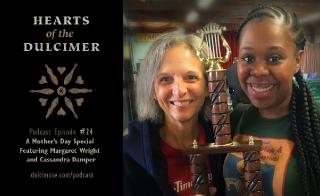
For this Mother’s Day, we’d like to celebrate all mothers who play dulcimer. We especially appreciate the dulcimer mothers who teach dulcimer to their children and to others. To honor all dulcimer mothers, we’re presenting the heartwarming story of a special dulcimer mother: Margaret Wright and her daughter Cassandra Damper.
Listen to the episode, see photos, videos, and more: http://dulcimuse.com/podcast/resource/024.html
Robin, thank you so much for this suggestion and especially for taking the time and trouble to record Supplication. We do both read music, so that helps. Your playing is inspiring...
Sorry to hear of Brian's passing. Rest in peace, Brian.
Very sorry to hear of Brians passing . We had many talks about building and finishing dulcimer. Truly a kind and gentile man. Rest in Peace Brian.
I was wondering about Brian. I had many delightful conversations with him on chat. I remember how excited he was to build his first dulcimer. I will miss him. I do remember him telling me about his breathing problems. I said some prayers for him that God will heal him. Well, being in the arms of the Savior is the ultimate healing. My prayers for his family and friends. He will be missed.
Sorry to learn about this. Although, we likely didn't have much interaction, learning about someone's passing from this community affects us all. May he rest in peace.
Prayers for all of his friends and family. Rest well, Brian. You will be missed.
Thank you for sharing this sad news, Jan. My sympathy goes out to all who knew Brian. I enjoyed chatting with him.
Ken
"The dulcimer sings a sweet song."
Sorry to hear of Brian's struggles and his passing.
May he rest in peace.
I hope Brian's passing was as peaceful as possible; he rests now where there is unspeakably beautiful music.
Thank you, Jan, for letting us know of Brian's death.
May Brian rest in peace. I'm glad he enjoyed his friends here while he was able. Having friends with which to share your joy of music is a powerful thing. Thanks Jan.
I am sad to report the death of our member, Brian Beach, who lived in the small community of Vasser, Michigan. Brian had been interested in the mountain dulcimer for years and had even made two, I believe. Brian suffered from COPD and had been unable to live on his own for awhile, needing a certain level of skilled care to bring him whatever comfort he could find. Brian treasured his FOTMD friends and enjoyed chatting and discussing a wide range of dulcimer topics. A humble man with a big smile and a caring heart, Brian will be missed by his dulcimer family.
Rest easy, Brian, and enjoy the music of the heavens that we can only barely imagine!
Have a look at the Sacred Harp hymns. They tend to be written in simple standard music notation for multi-part harmonies and many of them work well for noter drone playing. Here is Supplication played on an old Jethro Amburgey dulcimer with a two part harmony. I agree with Lisa when she says to lay back off the drones.
https://soundcloud.com/robin-clark-937720894/supplication-jethro-amburgey-dulcimer-25-feb-15
I knew you folks would have great ideas! Thanks so much! I play by ear, (N/D) and am just starting a few chords. Jenn is just starting dulcimer, watching what I do knee to knee in the old way. But she's a quick study, so we were already planning totry Dona Nobis Pacem. There will be lots of laughing...
Strumelia, good idea to back off of the drones! I think I can do that. Ta also for reminder of Blackest Crow harmony! I learned it from your tab; will try singing with the harmony. Time to revisit your beautiful blog anyway, now that I'm at a different place in my journey.
Greg - one part higher up, great!
Skip, would never have guessed about the Steven S. book. Will search for it.
Ken, I knew it was a stretch to think there'd be a book...I can play what I can hum, but not make up harmony on dulcimer.
And Lisa G, big thanks for the idea of rounds and the terrific list of partner songs. Never heardof partner songs before! whole new world!
Do I ever love fotmd!!
There's no reason one player couldn't use a noter and play the melody only (no drones) while the second player accompanied them with chords. I used to do this with a friend. He would play the melody only and I would accompany with chords, sometimes strumming across all strings for the full chord sound and sometimes breaking the chord up into an arpeggio (finger-picking single strings while holding the full chord). This worked really well with dulcimer and banjammer playing together. If you try this, have one player play their part higher up the neck and the other player play their part lower on the neck. The individual parts will resonate clearer this way. In case you're interested, my playing partner knew very little about chord playing. He was a self-taught single-string melody player. When his melody playing was harmonized with my chords, we both noticed an improvement in our music.
A separate book or tab was not needed, because most tab includes chord names above the tablature these days.
Some great ideas there! Strumelia is right -- one half of the duet really has to ignore the drones! Lisa's counter-melody is is a wonderful idea. And I never realized Stephen had done a JTJ Harmony book.
My student has just snow-birded back North for the summer, but I'll work up some of these ideas for when she returns...
Steven Seifert's Join the Jam and Join the Jam, Harmony may work for you. There may be other books with both melody harmony parts that might work for noter/drone also.
One playing an octave higher [add 7] or lower [playing a bass] may work some also.
I remember an old trick for playing a counter-melody in DAA tuning. Fret the middle string two frets down from the melody string. No reason this wouldn't work with two players, one playing the melody tab and the other playing the same tab but two frets lower. Listen while you do this, because sometimes that counter-melody doesn't sound good and then you can try sliding up or down a fret until it sounds better.
When all else fails, there are lots of rounds. Frere Jacques, Oh How Lovely is the Evening, Come Follow Me, Dona Nobis Pacem... You can probably find tab for these and they are automatically duet arrangements! Trios and quartets, too!
There's also what the Internet has just told me are called "partner songs." Like when you play "All Night, All Day" while I play "Swing Low, Sweet Chariot." This page says "Cindy" and "Liza Jane" play together. How about "He's Got the Whole World in His Hands" with "Go Tell Aunt Rhody"?
I'm not sure if this is but so helpful, because this is vastly smaller in size than what you're asking, but I have fallen in love with my 17" Feather Dulcimer. I loved playing my Walnut Creek, too, but there were songs I never could get that I seem to just play out of the blue now. That makes me think a 26.5" (and I see you added 25") might be beneficial to some.
Thanks hugssandi and others- your comments are indeed helpful. I decided to use a 25" fret board pattern for my April dulcimer 
Just lovely~thank you for blessing us!
Just my two cents but I think if two players are playing noter/drone style duets, it would be good if one or both of them knows how to lighten up on the drone strumming a little- perhaps a lighter touch or only intermittent full drone string strums. Otherwise it's going to be a pretty big 'wall o' drone'.
I don't have a book of noter duets, nor do I know of one. But here's one (free) noter style duet tab I wrote for The Blackest Crow, if that helps get you started:
https://dulcimer-noter-drone.blogspot.com/2009/05/blackest-crow.html
Duet books? There are barely any noter & drone books at all!
Something that could be fun is to work up duets using old and new versions of tune. For example there are 3 progressively older tunes for Auld Lang Syne, and I play the modern version as the verse and an older version as a chorus or refrain. The two tunes are similar enough they could be played together.
Thank you for the kind thoughts Cindy ,much appreciated !
JohnH
This is so beautiful.....so heartfelt.......
Thank you so much for re-posting it!
If only the world had a few more Frans!!!